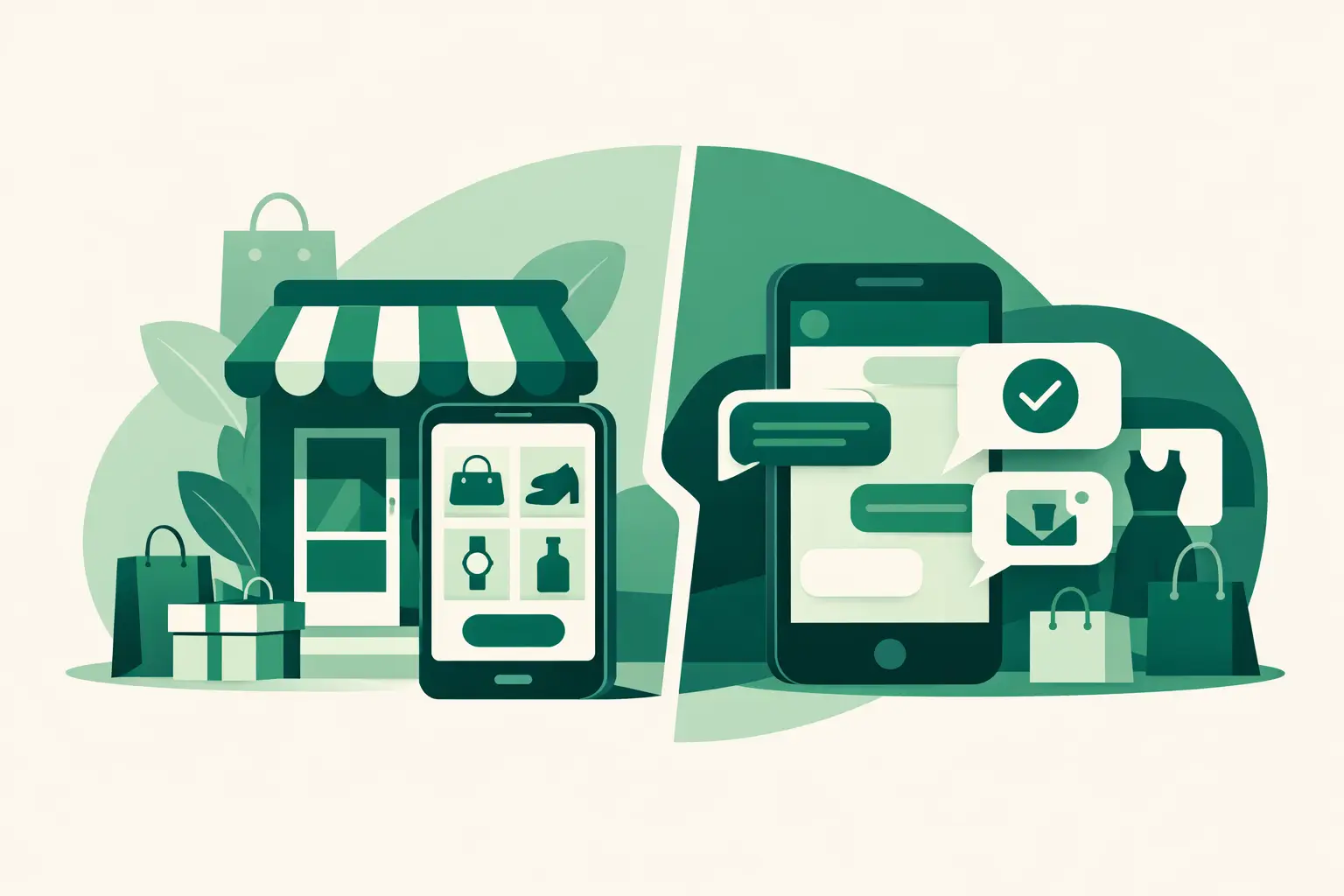
Storefront Link vs Instagram DMs: Which Sells More?
July 17, 2026
A customer replies to your Reel with “How much?” You send a price, then a photo, then another message explaining sizes. They ask whether blue is available. By the time you answer, the conversation has slipped below ten newer DMs. That is the real storefront link vs Instagram DMs decision: not whether you should stop talking to customers, but where the actual buying work should happen.
Instagram is excellent at getting attention. Your posts, Stories, and Reels can make someone want what you sell in seconds. But interest is only the first step. If every shopper has to ask for the same details before they can order, your inbox becomes the checkout counter, product catalog, stock list, and customer service desk all at once.
For a new seller with a few weekly orders, DMs can feel personal and manageable. As interest grows, the same process can create missed messages, repeated questions, and customers who give up before they order. A storefront link gives people a clearer path while letting you keep the friendly Instagram presence that brought them in.
What each option is really built to do
Instagram DMs are designed for conversations. They work well when a customer needs advice, wants a custom item, or has a question that cannot be answered by a product page. They also make your business feel accessible. A quick, helpful reply can turn a hesitant follower into a loyal customer.
A storefront is designed for browsing and ordering. It puts your products, photos, prices, options, and availability in one place. Instead of waiting for you to send three images and confirm a size, a customer can look through the collection, choose a variant, and place an order from their phone.
The difference matters because shoppers do not all buy the same way. Some want to chat before they decide. Others are ready to purchase at midnight, during a work break, or while you are packing orders. They should not have to wait for a reply just to learn what is available.
A storefront link does not replace your DMs. It removes the repetitive work that makes DMs hard to run as your main sales system.
Storefront link vs Instagram DMs: the daily reality
The easiest way to compare the two is to look at a normal selling day.
With DMs, each order usually starts from scratch. You answer “What colors do you have?” and “How much is this?” You search your camera roll for a photo, check whether an item is still available, collect an address, and try to remember who has confirmed. None of these tasks is difficult on its own. Together, they take attention away from making products, creating content, and serving customers well.
A storefront makes the common answers visible before a customer asks. Your product page can show the current color options, sizes, price, photos, and a clear order button. If you use stock counts, customers are less likely to select something that is no longer available. When they submit an order, the details are organized rather than scattered between message threads.
This is especially useful if you sell products with variants. A beauty seller may need customers to choose a shade or bundle. A clothing seller may need size, color, and fit. A food business may need a pickup date or flavor selection. In DMs, these details are easy to miss when several conversations are moving at once. On a storefront, the customer makes those choices as part of the order.
That said, DMs still have a place. Custom cakes, personalized gifts, consultations, and high-ticket products often need a conversation first. The better setup is usually not an either-or choice. Let your storefront handle standard orders, then use DMs for questions, special requests, and follow-up.
Where customers drop off
Every extra message creates a small chance that a buyer will disappear. They may get distracted before replying with their size. They may not want to ask for a price in the first place. They may see a product in a Story and decide it feels like too much effort to figure out how to buy it.
A link in your bio, Story, or post gives interested shoppers one clear next step: browse the store. It is simple, but clarity matters. People can see what you offer without feeling like they are starting a negotiation.
Pricing is a good example. Hiding prices can sometimes encourage conversation, but it also filters out buyers who want to decide quickly. If your prices are consistent, showing them on the storefront saves time for both sides. You can still invite customers to message you for recommendations or custom requests.
The same applies to product photos. In a DM, you may send one image at a time, often without the context of the full collection. In a storefront, customers can compare products at their own pace. That can lead to better choices and fewer basic questions in your inbox.
What a storefront changes for you
The biggest benefit is not that your business looks more polished, although it does. It is that you stop relying on memory to run orders.
When sales come through DMs, it is easy to lose track of who asked first, who confirmed, who changed their order, and who still needs a reply. You may use notes, screenshots, or a spreadsheet to stay organized. Those workarounds can help, but they add steps at the exact moment your business is getting busier.
A mobile-friendly storefront creates a more consistent order flow. Customers select what they want and submit their details in the same place. You can then review orders without digging through old conversations. After an order is placed on the storefront, you can receive and confirm it on WhatsApp, keeping communication familiar without making chat your order form.
You also gain a clearer view of what is happening in your store. Basic analytics can show which products people are viewing and ordering, helping you notice what deserves another post, a restock, or better photos. You do not need a complicated ecommerce operation to benefit from that visibility. You just need your sales activity to happen somewhere you can actually see it.
When DMs are enough, and when they are not
DM-only selling can be enough when your product range is tiny, your orders are occasional, and nearly every sale needs a personal quote. If you are testing a new idea with five products, messaging customers directly may be the fastest way to learn what they want.
The warning sign is not a specific number of orders. It is friction. If you repeatedly answer the same questions, spend evenings searching for order details, or worry that you missed someone who wanted to buy, you have outgrown an inbox-only process.
Another sign is content performance. If a Reel gets attention but few completed orders, your product may not be the problem. The path from “I like this” to “I bought this” may simply have too many steps. Sending shoppers to a storefront can make the transition from discovery to order feel more direct.
You do not need to build a large traditional website to solve this. For an Instagram-based business, a focused store with clear product pages and an easy mobile ordering flow is often the right amount of structure. Tools such as Dukkan are built around that reality: you can create a visual storefront without coding, manage it from your phone, and keep customer confirmation on WhatsApp.
A simple way to make the switch
Start with your best-selling products, not your entire catalog. Add clear photos, straightforward names, current prices, and the options customers ask about most. If a product has size or color variants, make those choices easy to select. Check your stock counts before sharing the link.
Then place the storefront link where buying intent is highest: your Instagram bio, product-focused Stories, and posts that feature a specific item. When someone messages “Price?” or “Available?”, reply warmly and point them to the product page. You are not brushing them off. You are giving them the fastest route to the full details and order form.
Keep watching what people still ask in DMs. Those questions tell you what your storefront needs next. Maybe a product needs a better size guide, another photo, a clearer description, or a note about delivery timing. Your inbox becomes useful feedback instead of a place where every order has to be manually rebuilt.
The goal is not to make your business feel less personal. It is to save your personal attention for the moments that actually need it. Let customers browse and order when they are ready, then show up in the conversation with the help, care, and confidence that brings them back.